

100% Real & Accurate CSP-Assessor Questions and Answers with Free and Fast Updates
Get Unlimited Access to CSP-Assessor Certification Exam Cert Guide
Swift CSP-Assessor Exam Syllabus Topics:
| Topic | Details |
|---|---|
| Topic 1 |
|
| Topic 2 |
|
| Topic 3 |
|
NEW QUESTION # 26
Select the correct statement about SWIFT Alliance Cloud.
*Connectivity
*Generic
*Products Cloud
*Products OnPrem
*Security
- A. Alliance Cloud is a cloud-based solution. It is offered by the 3 official public cloud providers. This allows customers the choice to select their preferred cloud provider
- B. Alliance Cloud is a SWIFT cloud-based solution. It consists of an Alliance Access instance deployed at one of the three SWIFT-approved public cloud providers
- C. Alliance Cloud is a SWIFT cloud-based solution. It provides a universal channel to the financial community and to SWIFT Value Added services and initiatives
- D. Alliance Cloud is a cloud-based solution. It is offered by any public cloud provider that subscribed to the digital connectivity initiative
Answer: B
Explanation:
SWIFT Alliance Cloud is a managed cloud service provided by SWIFT to deliver a fully hosted SWIFT infrastructure, reducing the local footprint for users. Let's evaluate each option:
*Option A: Alliance Cloud is a SWIFT cloud-based solution. It provides a universal channel to the financial community and to SWIFT Value Added services and initiatives This is partially correct but incomplete. Alliance Cloud is indeed a SWIFT-managed cloud solution, and it facilitates connectivity to the financial community and SWIFT Value Added Services (e.g., SWIFT gpi, Sanctions Screening). However, the term "universal channel" is vague and not a precise description of Alliance Cloud's functionality, which is more accurately defined as a hosted messaging and connectivity platform. This option lacks specificity about the deployment model.
*Option B: Alliance Cloud is a cloud-based solution. It is offered by the 3 official public cloud providers. This allows customers the choice to select their preferred cloud provider This is incorrect. Alliance Cloud is a SWIFT-managed service deployed on specific public cloud providers approved by SWIFT, not a solution where customers can choose any of the "3 official public cloud providers." SWIFT partners with select providers (e.g., AWS, Microsoft Azure, Google Cloud) but controls the deployment and configuration, limiting customer choice to SWIFT-approved instances.
*Option C: Alliance Cloud is a cloud-based solution. It is offered by any public cloud provider that subscribed to the digital connectivity initiative This is incorrect. Alliance Cloud is not available on any public cloud provider that subscribes to a "digital connectivity initiative." It is hosted exclusively on SWIFT-approved public cloud providers, ensuring compliance with SWIFT's security and operational standards. The term "digital connectivity initiative" is not a recognized framework in SWIFT documentation for Alliance Cloud.
*Option D: Alliance Cloud is a SWIFT cloud-based solution. It consists of an Alliance Access instance deployed at one of the three SWIFT-approved public cloud providers This is correct. Alliance Cloud is a SWIFT-managed cloud solution that includes a hosted Alliance Access instance (a messaging interface) deployed on one of the three SWIFT-approved public cloud providers (e.g., AWS, Microsoft Azure, Google Cloud). This setup provides a fully managed environment for SWIFT connectivity, reducing the user's local infrastructure needs. The CSCF applies to this cloud deployment, with SWIFT managing many security controls (e.g., "1.1 SWIFT Environment Protection"). SWIFT documentation confirms this model, emphasizing the use of approved providers.
Summary of Correct answer:
The correct statement is D, accurately describing Alliance Cloud as a SWIFT-managed solution with an Alliance Access instance on SWIFT-approved public cloud providers.
References to SWIFT Customer Security Programme Documents:
*SWIFT Customer Security Controls Framework (CSCF) v2024: Supports cloud deployments on approved providers (Control 1.1).
*SWIFT Alliance Cloud Documentation: Details the deployment on SWIFT-approved public cloud providers with Alliance Access.
*SWIFT Cloud Partnership Guidelines: Lists approved providers like AWS, Azure, and Google Cloud.
========
NEW QUESTION # 27
Which of the following statements best describes the difference between an audit and an assessment as per SWIFT CSP definitions? (Select the correct answer)
*Swift Customer Security Controls Policy
*Swift Customer Security Controls Framework v2025
*Independent Assessment Framework
*Independent Assessment Process for Assessors Guidelines
*Independent Assessment Framework - High-Level Test Plan Guidelines
*Outsourcing Agents - Security Requirements Baseline v2025
*CSP Architecture Type - Decision tree
*CSP_controls_matrix_and_high_test_plan_2025
*Assessment template for Mandatory controls
*Assessment template for Advisory controls
*CSCF Assessment Completion Letter
*Swift_CSP_Assessment_Report_Template
- A. An audit looks at the defined controls design and implementation compliance and follows recognized international audit standards, whereas an assessment is less strict but aims the same common objectives
- B. An audit is a comprehensive review of a customer's controls to ensure they meet regulatory requirements, while an assessment is a very high-level review of controls to identify potential weaknesses
- C. An audit and an assessment can be used interchangeably
- D. An audit is a one-time event, while an assessment is an ongoing process of monitoring and improving security controls
Answer: A
Explanation:
The "Independent Assessment Framework" and "Independent Assessment Process for Assessors Guidelines" distinguish between audits and assessments within the SWIFT CSP context. Let's evaluate each option:
*Option A: An audit is a comprehensive review of a customer's controls to ensure they meet regulatory requirements, while an assessment is a very high-level review of controls to identify potential weaknesses This is incorrect. The CSP assessment is a detailed, independent evaluation of CSCF compliance, not a high- level review. Audits may focus on broader regulatory compliance, but the CSP assessment is specific to CSCF controls.
*Option B: An audit looks at the defined controls design and implementation compliance and follows recognized international audit standards, whereas an assessment is less strict but aims the same common objectives This is correct. The CSP defines an assessment as a structured, independent process to verify CSCF control compliance, guided by SWIFT-specific guidelines rather than international audit standards (e.g., ISAE 3000).
Audits, while thorough, follow broader standards and may not align with CSP's tailored objectives. The
"Independent Assessment Process for Assessors Guidelines" supports this distinction, noting assessments are CSP-specific with a focus on effectiveness.
*Option C: An audit is a one-time event, while an assessment is an ongoing process of monitoring and improving security controls This is incorrect. Both audits and assessments can be one-time or periodic. The CSP assessment is an annual requirement, not an ongoing process, per the "Independent Assessment Framework."
*Option D: An audit and an assessment can be used interchangeably
This is incorrect. The CSP clearly differentiates between the two, with assessments being the mandated method for CSCF compliance.
An audit follows international standards for control compliance, while an assessment is CSP-specific with similar objectives but less strict standards (B).
References to SWIFT Customer Security Programme Documents:
*Independent Assessment Process for Assessors Guidelines: Defines assessment scope.
*Independent Assessment Framework: Distinguishes assessment from audit.
*Swift_CSP_Assessment_Report_Template: Outlines assessment process.
========
NEW QUESTION # 28
May an assessor approve a SWIFT User's KYC-SA attestation? (Select the correct answer)
*Swift Customer Security Controls Policy
*Swift Customer Security Controls Framework v2025
*Independent Assessment Framework
*Independent Assessment Process for Assessors Guidelines
*Independent Assessment Framework - High-Level Test Plan Guidelines
*Outsourcing Agents - Security Requirements Baseline v2025
*CSP Architecture Type - Decision tree
*CSP_controls_matrix_and_high_test_plan_2025
*Assessment template for Mandatory controls
*Assessment template for Advisory controls
*CSCF Assessment Completion Letter
*Swift_CSP_Assessment_Report_Template
- A. Yes, with agreement from the CISO of the SWIFT User
- B. No, it is the responsibility of the SWIFT user's internal audit to submit a CSP attestation
- C. Yes, if the KYC-SA application is set up in 2-eyes mode, it is possible for the assessor to submit and approve an attestation on behalf of the SWIFT user's
- D. No, the approval always remains the responsibility of the CISO of the SWIFT User (or similar level of responsibility)
Answer: D
Explanation:
The "Independent Assessment Process for Assessors Guidelines" and "Independent Assessment Framework" define the roles of assessors and SWIFT users in the KYC-SA (Know Your Customer - Security Attestation) process. Let's evaluate each option:
*Option A: Yes, if the KYC-SA application is set up in 2-eyes mode, it is possible for the assessor to submit and approve an attestation on behalf of the SWIFT user's This is incorrect. The 2-eyes mode (dual approval) applies to the user's internal process, not the assessor's role. The assessor conducts the assessment and provides a report, but the submission and approval of the attestation on the KYC-SA portal are the user's responsibility, typically by the CISO or an authorized officer.
*Option B: Yes, with agreement from the CISO of the SWIFT User
This is incorrect. CISO agreement does not authorize the assessor to approve the attestation; the CSP reserves this authority for the user.
*Option C: No, the approval always remains the responsibility of the CISO of the SWIFT User (or similar level of responsibility) This is correct. The "Swift_CSP_Assessment_Report_Template" and "CSCF Assessment Completion Letter" indicate that the assessor provides an independent evaluation, but the final approval and submission of the attestation on KYC-SA are the responsibility of the SWIFT user's CISO or an equivalent senior officer, as per the "Independent Assessment Process for Assessors Guidelines."
*Option D: No, it is the responsibility of the SWIFT user's internal audit to submit a CSP attestation This is incorrect. Internal audit cannot submit or approve attestations due to the independence requirement; this role belongs to the CISO or designated user representative.
Summary of Correct answer:
The assessor cannot approve the attestation; this responsibility lies with the CISO or similar user officer (C).
References to SWIFT Customer Security Programme Documents:
*Independent Assessment Process for Assessors Guidelines: Defines assessor and user roles.
*Independent Assessment Framework: Specifies user responsibility for attestation approval.
*Swift_CSP_Assessment_Report_Template: Outlines the assessment process.
========
NEW QUESTION # 29
The cluster of VPN boxes is also called managed-customer premises equipment (M-CPE).
- A. TRUE
- B. FALSE
Answer: A
NEW QUESTION # 30
The internet connectivity restriction control prevents having internet access on any CSCE m-scope components.
- A. FALSE
- B. TRUE
Answer: A
Explanation:
This question addresses the internet connectivity restriction control and its application to CSCF in-scope components. Let's verify this against Swift CSP guidelines.
Step 1: Understand the Internet Connectivity Restriction Control
TheSwift Customer Security Controls Framework (CSCF) v2024, underControl 2.6: Internet Accessibility Restriction, mandates that in-scope components (e.g., Swift messaging interfaces, communication interfaces) must not have direct internet access to prevent exposure to external threats. However, this control allows for exceptions under specific conditions.
Step 2: Analyze the Statement
The statement claims that the internet connectivity restriction control "prevents having internet access on any CSCF in-scope components." The key is to determine if this is an absolute prohibition or if exceptions exist.
Step 3: Evaluate Against CSCF Guidelines
* Control 2.6: Internet Accessibility Restrictionrequires that Swift-related systems be isolated from the internet to minimize attack surfaces. This includes components like messaging interfaces (e.g., Alliance Access) and communication interfaces (e.g., SNL).
* However, theCSCF v2024andSwift CSP FAQallow for controlled internet access under specific circumstances, such as:
* Use of secure tunnels (e.g., VPNs) or proxies for authorized management purposes.
* Temporary access for software updates or patches, provided it is tightly controlled and monitored (perControl 6.1: Security Event Logging).
* The control does not impose an absolute ban but requires that any internet access be restricted, audited, and justified. Thus, the statement that it "prevents having internet access on any CSCF in-scope components" is too absolute.
Step 4: Conclusion and Verification
The statement isFALSEbecause, while internet access is heavily restricted for in-scope components, it is not entirely prevented under all circumstances (e.g., controlled access for maintenance). This aligns with the flexible yet secure approach of theCSCF v2024.
References
* Swift Customer Security Controls Framework (CSCF) v2024, Control 2.6: Internet Accessibility Restriction.
* Swift CSP FAQ, Section: Internet Access Exceptions.
NEW QUESTION # 31
Which user roles are available in Alliance Cloud by default. (Choose all that apply.)
- A. Role and Operator management
- B. Message Security Administrator
- C. Administrator
- D. Message Management
Answer: A,C,D
Explanation:
This question pertains to the default user roles available in Alliance Cloud, a SWIFT cloud-based messaging solution:
* Step 1: Alliance Cloud Overview
* Alliance Cloud provides a hosted messaging service (e.g., for Alliance Lite2 or RMA), with predefined roles for managing operations, security, and messages. Default roles are outlined in the product documentation.
NEW QUESTION # 32
In the case that nothing has changed in the SWIFT user's infrastructure, is it possible to rely on a previous Independent assessment report without performing another independent assessment? (Select the correct answer)
*Swift Customer Security Controls Policy
*Swift Customer Security Controls Framework v2025
*Independent Assessment Framework
*Independent Assessment Process for Assessors Guidelines
*Independent Assessment Framework - High-Level Test Plan Guidelines
*Outsourcing Agents - Security Requirements Baseline v2025
*CSP Architecture Type - Decision tree
*CSP_controls_matrix_and_high_test_plan_2025
*Assessment template for Mandatory controls
*Assessment template for Advisory controls
*CSCF Assessment Completion Letter
*Swift_CSP_Assessment_Report_Template
- A. No, even if nothing has changed, an independent assessor needs to perform a full assessment including full testing every year
- B. Yes, full reliance can be provided if the CISO of the SWIFT user signs a letter which confirms that nothing has changed
- C. Yes, full reliance can be provided without the need of an independent assessment if nothing has changed
- D. No, even if nothing has changed, an independent assessor needs to assess the conditions before being able to rely on the previous year's assessment
Answer: D
Explanation:
The "Independent Assessment Framework" and "Independent Assessment Process for Assessors Guidelines" govern the frequency and reliance on previous assessments. Let's evaluate each option:
*Option A: Yes, full reliance can be provided without the need of an independent assessment if nothing has changed This is incorrect. The CSP requires an annual independent assessment, even if no changes occur, to verify ongoing compliance, as per the "Independent Assessment Framework."
*Option B: No, even if nothing has changed, an independent assessor needs to assess the conditions before being able to rely on the previous year's assessment This is correct. While the previous report can be used as a baseline, the assessor must perform a review (e.g., walkthroughs, spot checks) to confirm no changes or degradation in compliance, as outlined in the
"Independent Assessment Process for Assessors Guidelines" and
"CSP_controls_matrix_and_high_test_plan_2025."
*Option C: No, even if nothing has changed, an independent assessor needs to perform a full assessment including full testing every year This is incorrect. A full assessment is not always required; a review of conditions can suffice if no changes are identified, per CSP guidelines.
*Option D: Yes, full reliance can be provided if the CISO of the SWIFT user signs a letter which confirms that nothing has changed This is incorrect. CISO confirmation does not replace the assessor's independent review, as mandated by the
"Independent Assessment Framework."
Summary of Correct answer:
An assessor cannot rely fully on a previous report without assessing conditions (B).
References to SWIFT Customer Security Programme Documents:
*Independent Assessment Process for Assessors Guidelines: Requires annual review.
*Independent Assessment Framework: Mandates assessor validation.
*CSP_controls_matrix_and_high_test_plan_2025: Supports conditional reliance.
========
NEW QUESTION # 33
Can an internal audit department submit and approve their Swift user's attestation on the KYC-SA Swift portal?
- A. Yes, an internal auditor can submit the attestation for approval provided they have the appropriate credentials for switt.com. The CISO remains in charge of the approval of the attestation
- B. No, this is never an option
- C. Yes, with approval from the Chief auditor
- D. Yes, providing this is agreed by the head of IT operations and the CISO
Answer: A
NEW QUESTION # 34
Is the control 2. 11 "RMA Business Controls" only about the process of validating the defined counterparty relationships?
- A. Yes
- B. No
Answer: B
NEW QUESTION # 35
In the illustration, identify the component type of each of the numbered components.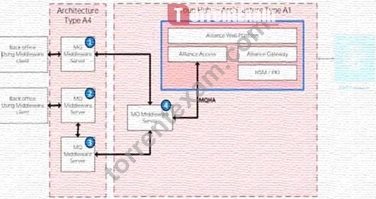
- A. 1. Customer Connector
2. Customer Connector
3. Customer Connector
4. Customer Connector - B. 1. Customer Connector
2. Bridging Server (Middleware Server)
3. Customer Connector
4. Customer Connector - C. 1. Bridging Server (Middleware Server)
2. Bridging Server (Middleware Server)
3. Bridging Server (Middleware Server)
4. Bridging Server (Middleware Server) - D. 1. Customer Connector
2. Bridging Server (Middleware Server)
3. Customer Connector
4. Bridging Server (Middleware Server)
Answer: D
Explanation:
This question requires identifying the component types of the numbered components (1, 2, 3, and 4) in the provided diagram, which illustrates a Swift infrastructure with Architecture Type A4 (user environment) and Architecture Type A1 (group hub). The classification is based on theSwift Customer Security Controls Framework (CSCF) v2024and related architecture definitions.
Step 1: Understand the Diagram and Component Types
* The diagram shows two environments:
* Architecture Type A4: The user's local environment with back-office systems using middleware clients and servers.
* Architecture Type A1: A group hub hosting Swift components like Alliance Access, Alliance Gateway, and HSM/PKI, connecting to the Swift network.
* Component Types:
* Customer Connector: A system or server that facilitates connectivity between the user's environment and the Swift infrastructure (e.g., middleware servers interfacing with the group hub).
* Bridging Server (Middleware Server): A server that bridges data flows between back-office systems and the Swift messaging environment, often handling message queuing or transformation.
Step 2: Analyze Each Numbered Component
* Component 1 (Middleware Server connected to Back Office 1):This server is part of the A4 architecture, interfacing the back-office middleware client with the group hub (A1). It acts as a connector, facilitating data exchange to the MQHA (Message Queue High Availability) server in the group hub. Per theCSCF v2024andSwift Architecture Types Explained, this is aCustomer Connector.
* Component 2 (MQHA Middleware Server in the Group Hub):This server is within the A1 group hub, bridging the user's data (via the customer connector) tothe Alliance Access and Gateway. It handles message queuing and acts as aBridging Server (Middleware Server), as defined in theSwift Alliance Gateway Technical Documentation.
* Component 3 (Middleware Server connected to Back Office 2):Similar to Component 1, this server connects the second back-office middleware client to the MQHA server in the group hub, functioning as aCustomer Connector.
* Component 4 (MQ Middleware Server connected to MQHA):This server within the A1 group hub supports the MQHA, bridging data flows to the Swift messaging components (Alliance Access
/Gateway). It is aBridging Server (Middleware Server), consistent with theCSCF v2024definitions.
Step 3: Match with Options
* A. 1. Customer Connector, 2. Bridging Server (Middleware Server), 3. Customer Connector, 4.
Bridging Server (Middleware Server): Matches the analysis above.
* B. 1. Customer Connector, 2. Bridging Server (Middleware Server), 3. Customer Connector, 4.
Customer Connector: Incorrect, as Component 4 is a bridging server, not a customer connector.
* C. 1. Bridging Server (Middleware Server), 2. Bridging Server (Middleware Server), 3. Bridging Server (Middleware Server), 4. Bridging Server (Middleware Server): Incorrect, as Components 1 and 3 are customer connectors, not bridging servers.
* D. 1. Customer Connector, 2. Customer Connector, 3. Customer Connector, 4. Customer Connector: Incorrect, as Components 2 and 4 are bridging servers.
Step 4: Conclusion and Verification
The correct answer isA, as it accurately identifies the component types based on their roles in the A4 and A1 architectures, consistent withCSCF v2024andSwift Architecture Types Explained.
References
* Swift Customer Security Controls Framework (CSCF) v2024, Control 1.1: Swift Environment Protection.
* Swift Architecture Types Explained, Section: Component Roles.
* Swift Alliance Gateway Technical Documentation, Section: Middleware and Connectors.
NEW QUESTION # 36
To verify the applicability of a CSCF control to a specific component, several actions may be considered.
Which one does not apply in this case?
*Swift Customer Security Controls Policy
*Swift Customer Security Controls Framework v2025
*Independent Assessment Framework
*Independent Assessment Process for Assessors Guidelines
*Independent Assessment Framework - High-Level Test Plan Guidelines
*Outsourcing Agents - Security Requirements Baseline v2025
*CSP Architecture Type - Decision tree
*CSP_controls_matrix_and_high_test_plan_2025
*Assessment template for Mandatory controls
*Assessment template for Advisory controls
*CSCF Assessment Completion Letter
*Swift_CSP_Assessment_Report_Template
- A. Check in the CSP Policy document
- B. Check appendix F of the CSCF
- C. Open a case with SWIFT support via the case manager on swift.com if further information or solution cannot be found in the documentation
- D. Check carefully the Introduction section of the CSCF
Answer: A
Explanation:
Verifying the applicability of a CSCF control to a specific component involves consulting relevant SWIFT documentation and processes. The "Swift Customer Security Controls Framework v2025" and associated guidelines provide the framework for this determination. Let's evaluate each option:
*Option A: Check in the CSP Policy document
This does not apply. The "Swift Customer Security Controls Policy" is a high-level document outlining the CSP's objectives and requirements but does not provide detailed guidance on control applicability to specific components. Control applicability is determined by the CSCF itself (e.g., through appendices or the control matrix), not the policy document, which is more strategic than operational.
*Option B: Check appendix F of the CSCF
This applies. Appendix F of the CSCF (or a similar appendix in the v2025 version) typically includes guidance on control applicability, mapping controls to different architecture types and components. This is a standard action for assessors, as noted in the "Independent Assessment Process for Assessors Guidelines."
*Option C: Check carefully the Introduction section of the CSCF
This applies. The Introduction section of the CSCF provides an overview of the framework's scope, objectives, and how controls apply to various components, making it a relevant resource for verification.
*Option D: Open a case with SWIFT support via the case manager on swift.com if further information or solution cannot be found in the documentation This applies. If documentation does not resolve the applicability question, SWIFT support via the case manager on swift.com is a recognized escalation path, as outlined in the "Independent Assessment Framework" and SWIFT operational guidelines.
Summary of Correct answer:
Checking the CSP Policy document (A) does not apply, as it is not the appropriate resource for verifying control applicability to specific components.
References to SWIFT Customer Security Programme Documents:
*Swift Customer Security Controls Framework v2025: Provides applicability guidance in appendices (e.g., Appendix F) and the Introduction.
*Independent Assessment Process for Assessors Guidelines: Recommends using CSCF appendices and support channels.
*CSP_controls_matrix_and_high_test_plan_2025: Supports control applicability analysis.
========
NEW QUESTION # 37
Select the components a SwiftNet Link (SNL) may communicate with. (Choose all that apply.)
- A. The VPN boxes
- B. The messaging interface (such as Alliance Access)
- C. The Graphical User Interface
- D. The HSM device
Answer: B,C,D
NEW QUESTION # 38
Can a Swift user choose to implement the security controls (example: logging and monitoring) in systems which are not directly in scope of the CSCE?
- A. No
- B. Yes
Answer: B
Explanation:
This question asks whether a Swift user can implement security controls (e.g., logging and monitoring) in systems not directly in scope of the CSCF. Let's analyze this based on Swift CSP guidelines.
Step 1: Define CSCF Scope and Security Controls
TheSwift Customer Security Controls Framework (CSCF) v2024defines its scope as the Swift-related infrastructure, including messaging interfaces, communication interfaces, and operator systems (asdetailed in Question 4). Security controls likelogging and monitoringare mandated underControl Objective 6: Detect Anomalous Activity, specifically in controls likeControl 6.1: Security Event Logging.
Step 2: Analyze the Question
The question focuses on whether a Swift user can apply CSCF security controls (e.g., logging and monitoring) to systemsnot directly in scopeof the CSCF. Systems not in scope include back-office systems, general- purpose servers, or other infrastructure that does not directly process Swift messages or connect to the Swift network.
Step 3: Evaluate Swift CSP Guidance
* The CSCF mandates that security controls must be applied to in-scope systems to ensure the security of the Swift environment. However, Swift also encourages adefense-in-depthapproach, as outlined in the Swift Customer Security Programme - Security Best Practices. This approach recommends extending security practices beyond the minimum scope to enhance overall security.
* Control 6.1: Security Event Loggingrequires logging and monitoring for in-scope systems to detect anomalous activity. While this control is mandatory for in-scope systems, the CSCF does not prohibit applying similar controls to out-of-scope systems. In fact, theSwift CSP FAQ(available on swift.com) clarifies that users may implement additional security measures on out-of-scope systems to reduce risks to the Swift environment (e.g., monitoring back-office systems that interact with Swift middleware).
* Implementing logging and monitoring on out-of-scope systems can help detect threats that might indirectly affect the Swift environment, such as lateral movement from a compromised back-office system to a Swift-related system.
Step 4: Conclusion and Verification
A Swift usercanchoose to implement security controls like logging and monitoring on systems not directly in scope of the CSCF. This is not mandatory but is considered a best practice under Swift's defense-in-depth strategy. The CSCF does not restrict users from applying additional security measures beyond its defined scope, and such actions align with the broader goal of enhancing cybersecurity across the user's environment.
References
* Swift Customer Security Controls Framework (CSCF) v2024, Control 6.1: Security Event Logging.
* Swift Customer Security Programme - Security Best Practices, Section: Defense-in-Depth.
* Swift CSP FAQ, Section: Scope and Applicability of Security Controls.
NEW QUESTION # 39
As a Swift CSP Certified Assessor, I left the listed provider and started to work independently. Can I continue to perform CSP assessments?
- A. [No, except if Swift formally provides you permission
- B. No, this is not allowed
- C. Yes. during the certification validity period
- D. Yes. but not as a Swift CSP Certified assessor
Answer: B
Explanation:
This question addresses the eligibility of a SWIFT CSP Certified Assessor who leaves a listed provider to continue performing assessments independently:
* Step 1: SWIFT CSP Assessor Certification Rules
* The SWIFT CSP Independent Assessment Framework (IAF) specifies that assessors must be certified and affiliated with a SWIFT-approved provider listed in the Directory of CSP Assessment Providers. Certification is tied to the individual but exercised through the provider's accreditation.
* Step 2: Impact of Leaving a Provider
* When an assessor leaves a listed provider, they lose the organizational backing required to conduct official CSP assessments. The IAF states that "assessments must be performed by approved providers," and independent operation without SWIFT's formal re-approval or affiliation with another provider is not permitted, even during the certification validity period.
NEW QUESTION # 40
What does the CSCF expect in terms of Database Integrity? (Choose all that apply.)
- A. Nothing is needed when the messaging or connector integrates/embeds an integrity check functionality at each Swift transaction record level.
- B. When a database is used by a messaging interface or connector, the related hosted database and its supporting system must be protected as a Swift-related component and exceptions alerted
- C. Alerts generated from performed integrity checks are captured and analysed for appropriate treatment
Answer: B,C
Explanation:
This question addresses database integrity expectations under theSwift Customer Security Controls Framework (CSCF) v2024.
Step 1: Understand Database Integrity Requirements
TheCSCF v2024, underControl 2.7: Database Integrity, mandates protection and monitoring of databases supporting Swift-related components to ensure data integrity and detect anomalies.
Step 2: Evaluate Each Option
* A. Nothing is needed when the messaging or connector integrates/embeds an integrity check functionality at each Swift transaction record levelIncorrect. Even with embedded checks,Control
2.7requires additional protection and monitoring of the database and supporting systems, not just reliance on transaction-level checks.Conclusion: Incorrect.
* B. When a database is used by a messaging interface or connector, the related hosted database and its supporting system must be protected as a Swift-related component and exceptions alerted Correct.Control 2.7requires that databases supporting messaging interfaces or connectors be secured (e.
g., in a secure zone) and that exceptions (e.g., integrity breaches) be alerted, per theCSCF v2024.
Conclusion: Correct.
* C. Alerts generated from performed integrity checks are captured and analysed for appropriate treatmentCorrect.Control 2.7andControl 6.1: Security Event Loggingmandate capturing and analyzing integrity check alerts to address potential issues, as detailed in theSwift Security Best Practices
.Conclusion: Correct.
Step 3: Conclusion and Verification
The correct answers areB and C, as these align withControl 2.7andControl 6.1requirements for database integrity and monitoring in theCSCF v2024.
References
* Swift Customer Security Controls Framework (CSCF) v2024, Control 2.7: Database Integrity, Control
6.1: Security Event Logging.
* Swift Security Best Practices, Section: Database Security.
NEW QUESTION # 41
Select the correct statement(s).
- A. To verify the signature the SwiftNetLink uses the signing private key of the receiver
- B. The certificate stored on the Swift Hardware Security Module is used during the decryption operation of a message
- C. The decryption operation uses the encryption private key of the receiver
- D. The public and private keys of a Swift certificate are stored on the Hardware Security Module
Answer: C,D
NEW QUESTION # 42
May an assessor rely on an ISAE 3000 report dating back 2 years to support a CSP independent assessment?
(Select the correct answer)
*Swift Customer Security Controls Policy
*Swift Customer Security Controls Framework v2025
*Independent Assessment Framework
*Independent Assessment Process for Assessors Guidelines
*Independent Assessment Framework - High-Level Test Plan Guidelines
*Outsourcing Agents - Security Requirements Baseline v2025
*CSP Architecture Type - Decision tree
*CSP_controls_matrix_and_high_test_plan_2025
*Assessment template for Mandatory controls
*Assessment template for Advisory controls
*CSCF Assessment Completion Letter
*Swift_CSP_Assessment_Report_Template
- A. Yes, provided there is no change to the SWIFT user's infrastructure
- B. No, that is too old, the maximum is 18 months
- C. Yes, there is no time limit for an ISAE 3000 report
- D. No, an ISAE 3000 report is no valid substitute as a rule
Answer: B
Explanation:
The "Independent Assessment Process for Assessors Guidelines" and "Independent Assessment Framework" provide guidance on using external audit reports (e.g., ISAE 3000) to support CSP assessments. ISAE 3000 is an international standard for assurance engagements. Let's evaluate each option:
*Option A: No, that is too old, the maximum is 18 months
This is correct. The CSP specifies that external reports like ISAE 3000 must be no older than 18 months to ensure relevance, as security environments can change. The "Independent Assessment Framework" and
"CSP_controls_matrix_and_high_test_plan_2025" set this time limit to validate current compliance status.
*Option B: Yes, there is no time limit for an ISAE 3000 report
This is incorrect. A time limit is enforced to ensure the report reflects the current security posture, as per CSP guidelines.
*Option C: No, an ISAE 3000 report is no valid substitute as a rule
This is incorrect. An ISAE 3000 report can be used as supporting evidence if relevant and recent, but it is not a full substitute for the independent assessment, per the "Independent Assessment Process for Assessors Guidelines."
*Option D: Yes, provided there is no change to the SWIFT user's infrastructure This is incorrect. Even with no changes, the 18-month limit applies to ensure the report's currency, not just infrastructure stability.
Summary of Correct answer:
An assessor cannot rely on an ISAE 3000 report dating back 2 years; the maximum is 18 months (A).
References to SWIFT Customer Security Programme Documents:
*Independent Assessment Process for Assessors Guidelines: Limits ISAE 3000 reports to 18 months.
*Independent Assessment Framework: Specifies timeframe for external evidence.
*CSP_controls_matrix_and_high_test_plan_2025: Enforces currency of supporting reports.
========
NEW QUESTION # 43
What are the key elements that usually need to be considered by a cloud provider in an IaaS cloud model?
(Select the two correct answers that apply)
*Swift Customer Security Controls Policy
*Swift Customer Security Controls Framework v2025
*Independent Assessment Framework
*Independent Assessment Process for Assessors Guidelines
*Independent Assessment Framework - High-Level Test Plan Guidelines
*Outsourcing Agents - Security Requirements Baseline v2025
*CSP Architecture Type - Decision tree
*CSP_controls_matrix_and_high_test_plan_2025
*Assessment template for Mandatory controls
*Assessment template for Advisory controls
*CSCF Assessment Completion Letter
*Swift_CSP_Assessment_Report_Template
- A. The cloud provider must cover all CSCF controls applicable to the related in-scope components for which the cloud provider is responsible (such as the underlying infrastructure in line with appendix G)
- B. The cloud provider must give comfort of control implementation effectiveness on the virtualization layer hosting the SWIFT users' components
- C. The cloud provider must give comfort regarding the resiliency put in place to ensure continuity of SWIFT connectivity service
- D. The cloud provider must give full assurance on the change management process of the SWIFT-users' components/applications deployed by the user
Answer: A,B
Explanation:
In an Infrastructure as a Service (IaaS) cloud model, such as SWIFT's Alliance Cloud, the cloud provider is responsible for the underlying infrastructure (e.g., hardware, virtualization layer, network) while the customer manages the applications and data. The SWIFT CSP, particularly the "Outsourcing Agents - Security Requirements Baseline v2025" and "Swift Customer Security Controls Framework v2025," outlines the responsibilities of cloud providers. Let's evaluate each option:
*Option A: The cloud provider must cover all CSCF controls applicable to the related in-scope components for which the cloud provider is responsible (such as the underlying infrastructure in line with appendix G) This is correct. In an IaaS model, the cloud provider is responsible for securing the underlying infrastructure (e.g., physical servers, network, virtualization layer) that hosts the SWIFT components. Appendix G of the CSCF (or related outsourcing guidelines) specifies the controls the provider must implement, such as those under CSCF Control "1.1 SWIFT Environment Protection" and "2.3 System Hardening." The provider must ensure these controls are met for the infrastructure it manages.
*Option B: The cloud provider must give comfort of control implementation effectiveness on the virtualization layer hosting the SWIFT users' components This is correct. The virtualization layer (e.g., hypervisors) is part of the IaaS provider's responsibility, and the provider must provide assurance (e.g., through audits or reports) that security controls are effectively implemented. This aligns with CSCF requirements for outsourcing agents, ensuring the virtualization layer supports the SWIFT secure zone, as noted in the "Independent Assessment Framework."
*Option C: The cloud provider must give full assurance on the change management process of the SWIFT- users' components/applications deployed by the user This is incorrect. Change management for the SWIFT-users' components (e.g., Alliance Access configurations) is the customer's responsibility in an IaaS model. The cloud provider is not accountable for the applications deployed by the user, only for the underlying infrastructure. The "Outsourcing Agents - Security Requirements Baseline v2025" clarifies this boundary.
*Option D: The cloud provider must give comfort regarding the resiliency put in place to ensure continuity of SWIFT connectivity service This is incorrect as a primary key element. While resiliency is important (e.g., CSCF Control 1.1), it is a broader operational concern rather than a specific IaaS responsibility. The provider ensures infrastructure availability, but continuity of SWIFT connectivity is a shared responsibility, with the customer managing the communication interface (e.g., Alliance Gateway).
Summary of Correct Answers:
The key elements for a cloud provider in an IaaS model are covering applicable CSCF controls for the infrastructure (A) and providing comfort on the effectiveness of controls on the virtualization layer (B).
References to SWIFT Customer Security Programme Documents:
*Swift Customer Security Controls Framework v2025: Defines responsibilities in cloud models (Control 1.1, Appendix G).
*Outsourcing Agents - Security Requirements Baseline v2025: Outlines provider responsibilities in IaaS.
*Independent Assessment Framework: Requires assurance on virtualization layer security.
========
NEW QUESTION # 44
The control SWIFT Environment Protection supports several objectives. (Select the one that does not apply)
*Swift Customer Security Controls Policy
*Swift Customer Security Controls Framework v2025
*Independent Assessment Framework
*Independent Assessment Process for Assessors Guidelines
*Independent Assessment Framework - High-Level Test Plan Guidelines
*Outsourcing Agents - Security Requirements Baseline v2025
*CSP Architecture Type - Decision tree
*CSP_controls_matrix_and_high_test_plan_2025
*Assessment template for Mandatory controls
*Assessment template for Advisory controls
*CSCF Assessment Completion Letter
*Swift_CSP_Assessment_Report_Template
- A. Limit risks of privileged accounts compromise
- B. Limit risks of lateral movement
- C. Forbids any interactive sessions towards the SWIFT infrastructure
- D. Restrict malicious access from external sources
Answer: C
Explanation:
CSCF Control "1.1 SWIFT Environment Protection" aims to secure the SWIFT infrastructure by isolating it from external threats and internal risks. The "Swift Customer Security Controls Framework v2025" details its objectives. Let's evaluate each option:
*Option A: Restrict malicious access from external sources
This applies. Control 1.1 requires isolating the SWIFT secure zone from external sources (e.g., the Internet) to prevent malicious access, such as malware or unauthorized intrusions.
*Option B: Forbids any interactive sessions towards the SWIFT infrastructure This does not apply. Control 1.1 does not forbid all interactive sessions. It allows controlled interactive access (e.g., via jump servers) for administrative purposes, provided sessions are secured (e.g., encrypted per Control
"2.1 Internal Data Transmission Security"). The "CSP_controls_matrix_and_high_test_plan_2025" permits interactive sessions with proper controls.
*Option C: Limit risks of privileged accounts compromise
This applies. Control 1.1 includes measures to secure privileged accounts (e.g., by enforcing strong authentication and role-based access control) to prevent compromise, aligning with CSCF principles.
*Option D: Limit risks of lateral movement
This applies. Control 1.1 aims to segment the SWIFT environment from the general IT environment, reducing the risk of lateral movement by attackers within the network.
Forbidding any interactive sessions (B) does not apply, as Control 1.1 allows controlled interactive access.
References to SWIFT Customer Security Programme Documents:
*Swift Customer Security Controls Framework v2025: Control 1.1 objectives include restricting access and limiting risks, but not banning interactive sessions.
*CSP_controls_matrix_and_high_test_plan_2025: Confirms controlled interactive sessions are permitted.
*Independent Assessment Framework: Assesses secure access controls under 1.1.
========
NEW QUESTION # 45
......
Reliable Study Materials for CSP-Assessor Exam Success For Sure: https://actualtests.torrentexam.com/CSP-Assessor-exam-latest-torrent.html
